
schreckstoff
-
Posts
293 -
Joined
-
Last visited
Content Type
Profiles
Forums
Events
Gallery
Store
Everything posted by schreckstoff
-
 FYI https://www.epa.gov/newsreleases/join-epa-rochester-share-your-views-great-lakes-restoration-and-protection Mtg is tomorrow evening.
 -
Net Pen in 130 ft of water N of Oswego, trollers beware
schreckstoff replied to schreckstoff's topic in Open Lake Discussion
Stephanadams - great question. We suspect they spawn 'deep' in main lake habitats based on catches of spawning condition adults in Jan-Mar and larvae in Jun-Aug, but their actual spawning behavior, habitat, or eggs have never been documented to my knowledge. 'Deep' might be 150 - 600 feet of water. Hopefully we can get some observations from Lake Michigan to fill in those unknowns to help inform us whether Lake Ontario has similar habitat/conditions. -
Sandy 7/6 morning and evening
schreckstoff replied to Hamlin's topic in New York Fishing Reports - Lake Ontario (South Shore)
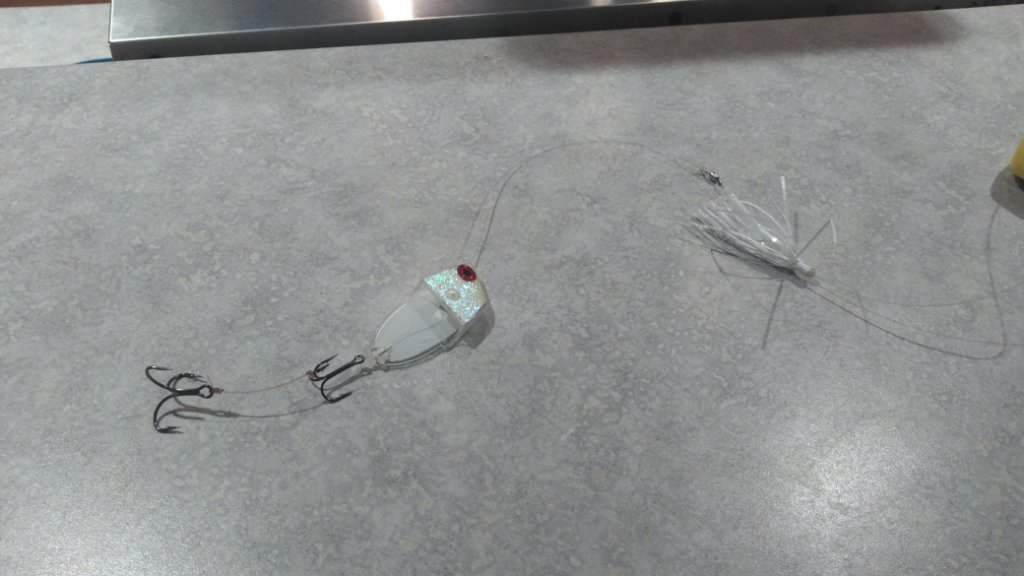 thanks for the tips and the spoon name!
 -
Sandy 7/6 morning and evening
schreckstoff replied to Hamlin's topic in New York Fishing Reports - Lake Ontario (South Shore)
Nice and great report, thanks. Are you saying the treble was the mistake? Do u prefer running single hooks? I like That spoon! Does it have a name? -
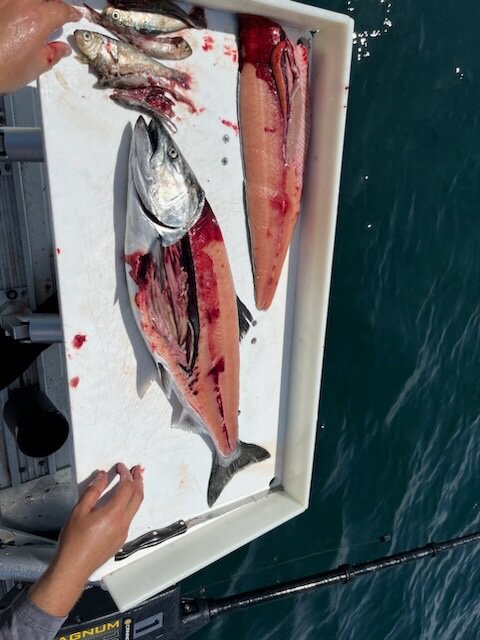 Wondering what folks are seeing in the stomachs or on their graphs. Anything unusual, or different for this time of year?
 -
How was the mtg? Was it well attended?
-
Upwelling Impact on Salmon
schreckstoff replied to Apparition's topic in Questions About Trout & Salmon Trolling?
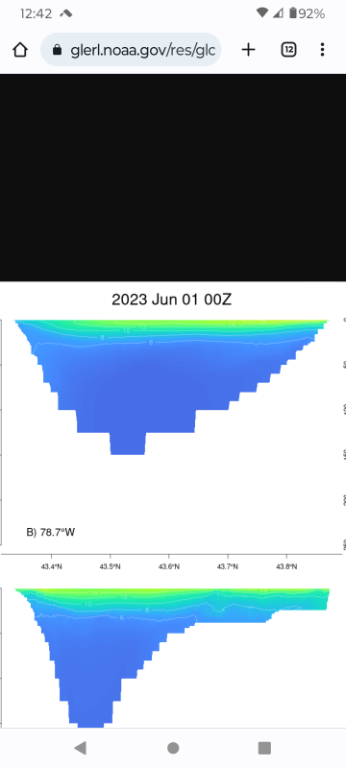 Apparition, I think the differences in the maps may be because GillTs map is based on satellite observations and the map you were showing is the results of the FVCOM model, for surface temperature. The Finite Volume Coastal Ocean Model uses bathymetry, wind, and air temperature observations data and a bunch of equations to make predictions, whereas I think satellites are using direct infrared observations, which have trouble with clouds and are only surface temps. I’m out. Of my depths on this stuff but the NOAA sites and google have much better explanations. The FVCOM approach is state of the art and it’s super cool that GLERL has it up and running. For my research we use it a lot in the spring to figure out when and where we might dodge the ice to start sampling as early as possible in Chaumont Bay.
 -
Net Pen in 130 ft of water N of Oswego, trollers beware
schreckstoff replied to schreckstoff's topic in Open Lake Discussion
Oswego net pen and marker buoys are removed. We appreciate everyone's patience. We learned a lot about the process. We won't know the results until trawl surveys next year where we will see if we catch these Bloater in different proportion to those that were direct stocked. -
My videography colleagues (https://m.facebook.com/AllTooClearFilm/) turned me on to Davinci Resolve, its free version seems quite powerful. There are lots of online tutorials,
-
Net Pen in 130 ft of water N of Oswego, trollers beware
schreckstoff replied to schreckstoff's topic in Open Lake Discussion
I take no offense nor blame and I think the discussion & debate is healthy. These threads are my favorite part of LOU. GillT is right, that Bloater and LT rearing is Federal, but as requested by the Lake Ontario Committee. The net is still out there, we are hoping to pull it on Friday. Thank you for your cooperation steering clear of the buoys! -
Net Pen in 130 ft of water N of Oswego, trollers beware
schreckstoff replied to schreckstoff's topic in Open Lake Discussion
Dances, yes. Like the pen stocked trout and salmon we are testing if we can improve survival when they have a few days to become ‘conditioned’ to the water where they are stocked. This is our first time trying anything like this so quite a few obstacles to overcome. I’m aware of Cisco eating alewife in Lk Michigan and probably annywhere there are big Cisco and small alewife , but I haven’t heard or seen evidence of Bloater eating Alewife. Cisco tend to live shallower and closer to shore, whereas Bloater are smaller, live deeper, and focus on eating Mysis shrimp. -
Net Pen in 130 ft of water N of Oswego, trollers beware
schreckstoff replied to schreckstoff's topic in Open Lake Discussion
Great question, it’s never to my knowledge been observed but all the evidence suggests deep reef/rock/gravel spawning. The commercial fishers. Are probably the best source of that info. I’m Not sure we have habitat in LO anymore. I’m hoping we get some projects trying to figure that out, but information has a hard time going upstream in the Great Lakes. -
The pen is north west of the lighthouse, is marked with 4 high flying float flags surrounding it, and 2 yellow surface floats. The net will be in that location till Monday and then there may be another one set for a few days deeper. These are experiments testing ways to increase survival of stocked Bloater. Best to give the marker buoys a wide berth to avoid snagging and losing gear. Happy to address questions or concerns. Thank you! -Brian Weidel
-
Great Lakes Fishery Commission puts out schedules that might have what you are looking for. Past few years are below. 2021 http://sealampreycontrol.info/temp/2021 Treatment schedule.pdf 2022 http://www.glfc.org/temp/2022 Treatment schedule.pdf 2023 http://www.glfc.org/temp/2023 Treatment Schedule.pdf
-
West is best
-
Land lock or brown?.. I mean goby or sculpin
schreckstoff replied to Roys Boys's topic in Finger Lakes Discussion
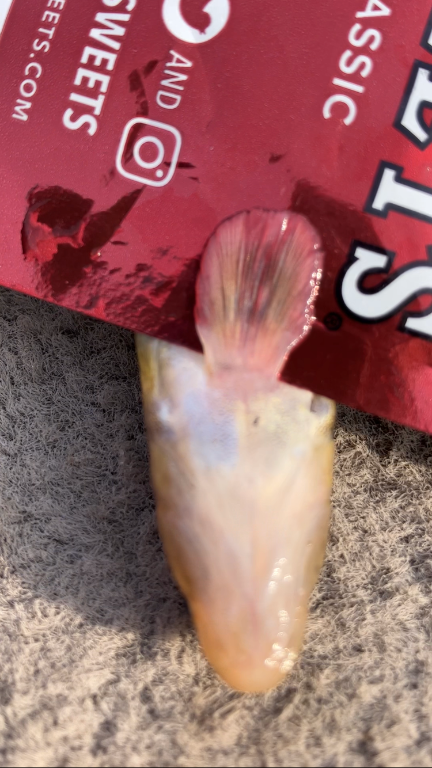 Round Goby
 -
 What Whaler said!! The forecast is dismal right now.
 -
Water level appears “up” to me (observing from Oswego). IJC graph suggests about 8” above average.
-
Well put!
-
Record Alewife year class?
-
Thanks for the update!
-
 A Lake Ontario specific study on this topic: Bioaccumulation of perfluoroalkyl substances in a Lake Ontario food web https://www.sciencedirect.com/science/article/abs/pii/S0380133021001799
 -
Oldest I see in our records is Age-7. Not many in that age (0.06%) and length on the age-7 ranged from 6 to 8 inches. Largest I see that we interpreted an age is almost 9 inches and that one was interpreted as age-4. You might have seen in my talks how Alewife growth (size at age) changes when fish hook and spiny water flea populations are really abundant. Interestingly those changes didn't seem to change RS growth.
-
Interesting, Thanks for sharing !
-
I think it might not be done for a year or so. They have some really cool Salmon footage from L Michigan. They are amazing videographers, I am hoping to try and film deep April Alewives, out in 400ft, this Spring. Oh that’s 120m for Yankee, ha!