


TyeeTanic
-
Posts
1,560 -
Joined
-
Last visited
Content Type
Profiles
Forums
Events
Gallery
Store
Everything posted by TyeeTanic
-
Which down speed & temp system do you recommend?
TyeeTanic replied to Todd in NY's topic in Tackle and Techniques
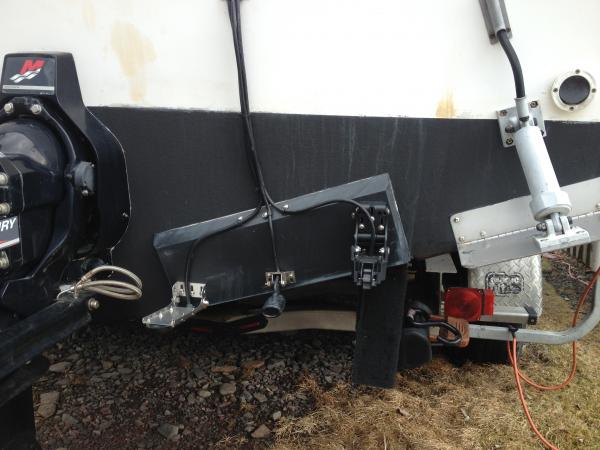 Almost not possible to measure a fish 60 ft behind the transom and get a hard return. The fish is not dense enough. You might see fish out but the color will always be light (soft signals). If you see that Brite yellow core in the arch it's basically under your transducer.
 -
Which down speed & temp system do you recommend?
TyeeTanic replied to Todd in NY's topic in Tackle and Techniques
Todd. The issue is where you measure fish is right under the transducer. The top of the arch is the true depth of the fish (assuming you have a hard return). So even if your ball looks like it's at the same depth as the fish it isn't. The fish is likely 20 ft or so deeper. -
Which down speed & temp system do you recommend?
TyeeTanic replied to Todd in NY's topic in Tackle and Techniques
Todd put your weights on a scale. If you need accuracy, weigh yourself, get off, and then hold the weight and reweigh. Difference in weight will tell you. I have the 12 lb torpedoes. They are the best out there in my opinion. Good tracking and much less blowback for the same weight in other styles. -
Which down speed & temp system do you recommend?
TyeeTanic replied to Todd in NY's topic in Tackle and Techniques
Your fish finder will not tell you how deep your riggers are. It only tells you how far away the ball is from the transducer. Think of it like this. Take a 12" string and hold the top. Where you pinch it is the transducer. The string should be going straight down due to gravity. Now with your other hand arch the bottom of the string back. Your FF will say it's 12" deep, as the string is still 12" long and that far from the transducer. But as you pull it back you will see it starts to come off the bottom. Your FF has no way of telling how far back or off the bottom the ball is, only how far the ball is away from the transducer. You need a probe to tell you the true depth. -
When are you going? The fishing you do will be very dependent on when you go. Right now it's grouper. If you want to do some tarpon fishing, which is highly recommended you have to wait until May. Amberjacks are good after that. King Mack's are great fishing too, I just can't remember when they come in.
-
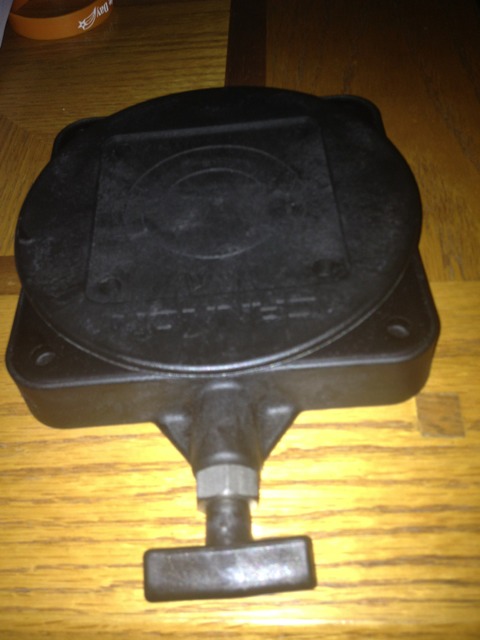 I've used scottys they are great, reliable, strong (and definitely could support a beer).
 -
Which down speed & temp system do you recommend?
TyeeTanic replied to Todd in NY's topic in Tackle and Techniques
This post talks about using smart troll with as much as 600 ft of copper out. http://www.glanglerforum.com/forum/archive/index.php/t-16725.html?s=10370844267e3a9e3633bc2d967fc988 -
Which down speed & temp system do you recommend?
TyeeTanic replied to Todd in NY's topic in Tackle and Techniques
I've had them out on flat wire lines (not weighted down by something), probably 300 ft and still got signal. I think the inventor has tested out 400 ft. I know bloodrun did some work using smart troll to figure out the depth of their copper, and I'm pretty sure it went past 300 ft. -
Which down speed & temp system do you recommend?
TyeeTanic replied to Todd in NY's topic in Tackle and Techniques
Todd the line counter on the rigger is less of an issue than blowback. With a 12 lb weight going 2.5 mph you will be suprised to learn the ball is tracking 30 to 40 ft behind the boat at certain depths. You will also find out how you get diminishing returns as you put the rigger deeper. You will be suprised how much cable you need put to get down 100 ft. Blowback is a big issue unless you are using 16 lb to 20 lb rigger weights. Most guys use 10 to 12 lbs and I can tell you first hand I'd never go back to a 10 lb weight dup to the insane blowback. -
Perhaps would be good to mention the rim diameter. But for those that don't know, these nets are awsome, and that price is great brand new.
-
Which down speed & temp system do you recommend?
TyeeTanic replied to Todd in NY's topic in Tackle and Techniques
A couple of things on Smart Troll. Firstly you DON'T lose probes on wire and copper! The probe gets attached on the steel line about 1 or more feet away from the terminal tackle (dipsey, leader, etc). When there's a break it is almost always on the mono or a knot. Unless you've put the probe on a compromised steel line (has a kink), it will remain attached to the line even with a break off! So just make sure you put the probe on a clean wire line! Second, I also have the precision trolling book. Two issues - the data is for a certain lure speed (2.5 mph) and with a known amount of line out! We all do different speeds, especially with currents - so this already introduces error. Second we are dependent on our line counters, which ARE NOT ACCURATE. They are only accurate (sort of) when the reel is full. As you pull off line, one revolution is no longer carrying as much line as the previous, and the counter only works on revolutions. It's so bad that when the reel is almost empty the counter is saying one foot of line comes off when only 0.4 - 0.5 ft of line actually comes off! That's over 50% error! The only way to know the true depth of your line is to measure it directly. I was suprised how far off all my lines were when I started using Smart Troll. My riggers were 20 ft too high and similarly my wire lines. Some people may say, why do you need all that info. Well, I use the info when I get a bit (what speed, what temp, what depth, what happened to my line when I made that turn) to (a) tune into what the fish want quicker and (b) help me get setup for the next fishing episode. We all know 6 AM - 9AM is the best bite (most days), so why wouldn't you want to use that time as efficiently as possible and put 15 fish in the boat rather than 2 because you spent all morning trying to figure out what the heck will work! -
Which down speed & temp system do you recommend?
TyeeTanic replied to Todd in NY's topic in Tackle and Techniques
The probe is very small about the diameter of a 10 cent coin. It has internal rechargeable batteries. I've fished for 6 hours straight with them and still at 90% charge. -
Which down speed & temp system do you recommend?
TyeeTanic replied to Todd in NY's topic in Tackle and Techniques
Yes preference and features. The X4 cannot do what the smart troll does. -
Which down speed & temp system do you recommend?
TyeeTanic replied to Todd in NY's topic in Tackle and Techniques
I have an I/O. I'm pretty sure they have fixed the interference issues. -
Which down speed & temp system do you recommend?
TyeeTanic replied to Todd in NY's topic in Tackle and Techniques
If you are worried about breakoffs the smart troll can still be hooked onto the rigger cables as per the fishhawk. In fact you can put a probe on each rigger to get true depth of each one plus you can track top and bottom of the thermocline. However I've had a smart troll for 4 years and have never lost a probe. The way it's secured to the wire line will mean it would take a catastrophic accident to lose the probe. Chances are basically none of losing the probe. Although I appreciate a new users concern over this, it actually isn't an issue at all. Knowing where your copper and wireline is will suprise you. Most of the time we are a good 10 to 25 ft off target which is important for fish that are turned off. Anyhow my buddy uses the X4 and it's reliable but the smart troll does have an irrefutable technical advantage over the fishhawk. -
Which down speed & temp system do you recommend?
TyeeTanic replied to Todd in NY's topic in Tackle and Techniques
Smart Troll. No other system can do what it does. You can put up to 6 probes on one system including on copper or wire lines. Least blowback. Very versatile. -
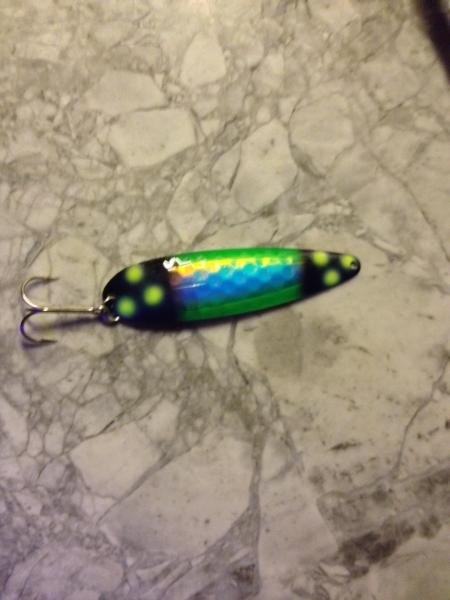 Well I had one UV spoon that took a lot of hits, more than average. It was a Dreamweaver Blue Leopard Double UV. Got it at the LOTSA Salmon School last Jan! It seemed to work best when the sun was up just after 8 am. Anyhow my line got cutoff after a tangle and I haven't been able to replace it since. I've used other UV lures, and they really didn't show any magic, but that one Dreamweaver became a go to for me.
 -
Trolling plate is an option, but you lose maneouverability as the thrust is taken away. Some people cut a hole in the plate to help with this. I used one for a limited perior, and as long as you didn't need to move fast it was okay. Definitely you need one that comes up easy for full throttle conditions - I had one that I think was called Happy Troller. I tilted the motor up and pulled the plate into the neutral position when I wanted to go at speed.
-
Sold / Closed Pro Troll e-chips and Spindoctors
TyeeTanic replied to troubles's topic in Classifieds - Buy, Sell, Trade or Rent
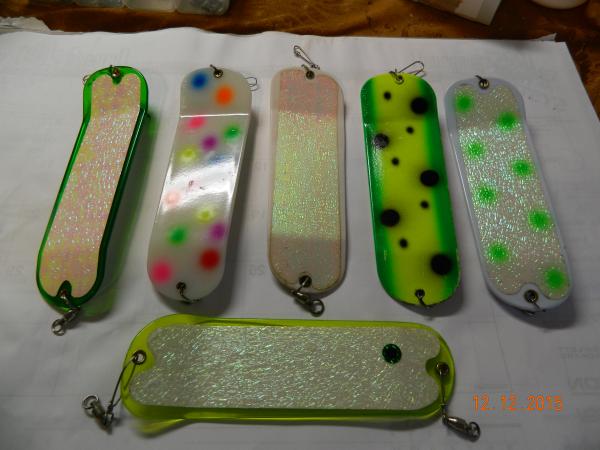 A few good colors right there. Have most of them. Someone should pick these up.
 -
I agree meat works best in June onwards.
-
I've had the same braid on my salt water rods (Florida) for 4 years. Just caught a 30 lb Amberjack with those rods in August. Braid lasts a long time. I agree I look for color change and cut off if I need to.
-
Torpedo has the smallest blowback. I learned the hard way. I wouldn't use less than 12 pounds.
-
Nuclear power is actually one of the cheapest forms of energy out there. However it can't compete with burning natural gas to make power. But burning natural gas contributes to green house gases. So the real cost of burning natural gas is on the health of our planet.
-
Yes, fall is the best time. I have been told acidic compounds can be present in the old oil, and it's best to change the oil, run the engine a bit to get the parts coated up and then winterize.
-
I would definitely consider 1 rigger rod with a slider and one dipsy rod. Dipsy's catch about 3 to 4 times more fish for me than the leadcore or copper. If fish are up high (top 30ft) then running a core might be a good idea, perhaps first thing in the morning. But as fish go deeper, then I'd definitely trade the core for a dipsey. One way to keep core in the mix is to make up a SWR rod. This is a downrigger rod with 2 colors of core on it, and a 15 ft fluoro leader. The core gets the lure below the rigger weight wake. However, with a SWR you cannot use a slider, as it will stop on the knots and tangle.