


TyeeTanic
-
Posts
1,560 -
Joined
-
Last visited
Content Type
Profiles
Forums
Events
Gallery
Store
Everything posted by TyeeTanic
-
 Spro swivels are REALLY good, but also very expensive. I still use them though.
 -
Terminal Tackle for Wire Dipsy Setups
TyeeTanic replied to jigstick's topic in Tackle and Techniques
You don't need all that stuff. Either your wire kinked or your knot is no good. Use this knot, I've had this knot on some of my wires for 4 years, and no problems. I've never snapped my wire. Make sure you keep your wire under tension always, and avoid pigtail kinks. Inspect your knot and retie if necessary. http://www.lotsa.org/Wire%20Line%20Knot.htm On the above, I tie the overhand knot first before I connect the snap swivel. And use a good snap swivel, with ball bearings like spro. -
Depth to put my spoons
TyeeTanic replied to Chinook Chaser's topic in Questions About Trout & Salmon Trolling?
You will learn a lot as an observer at tournaments. The pressure is on for guys to catch fish, so they will use every trick under their sleeve. Back to specifics - how long were your leads? How deep (water depth) were you? How deep were your spoons? What color spoons? What leader are you using on your rods? -
I would try running a 5th or 6th line. You could try 4 rigger rods (stacked on each rigger, about 20 to 30ft apart). You could try 4 dipsey divers (setting 1 and 3, starboard and port). You could try a leadcore or copper, or even leadcore/torpedo off inline planer boards. 8# ball will have lots of blowback. To get down 90 ft, you will need probably all 150 ft of cable out, maybe more, depending on speed and currents. YOU CANNOT TRACK BALL DEPTH WITH YOUR GRAPH. Sorry MarkMonkey1, that is not correct. The graph tells you how far the ball is away from the transducer, that is not the same thing as depth. If you could hang your weight from your transducer using a string 100 ft long the graph will tell you it's 100 ft deep. Take that string and pull the weight back behind the boat and start swinging it up (blow back), the graph will still tell you it's 100 ft deep, because that's how far the weight is from the transducer. If you want true depth, you need to have a depth measurement device. It won't matter if you only want to get down 40 ft or so, but deeper than that, the blowback makes a huge difference on actual ball depth.
-
Spoons....flys....dogers....flashers...cranks ?
TyeeTanic replied to fatboyjack1's topic in Tackle and Techniques
A spin doctor/fly setup will be the leading setup for taking fish in late June to mid-August. I would not exclude this setup from my arsenal. -
Yes, 15 lb's is enough if fleas aren't a problem. I've landed 25 lb kings on 8 lb lines (center pin rod). It takes forever to bring them in, but it's possible. I wouldn't use 15 lbs on the lake for 2 reasons - (1) fleas are a problem and they will grab onto that line size. (2) It takes longer to get the fish in, and that puts the fish in greater distress - so unless you plan on keeping it, you have to think of the mortality rate if fish is put under stress for longer periods.
-
copper questions for a new guy
TyeeTanic replied to mcconnell14's topic in Questions About Trout & Salmon Trolling?
Where do you fish if you are North of Toronto? Lake O has an awesome salmon fishery. In about 1 month it's going to be on fire across the north shore. -
30 lb is good. 20 lb leader for rigger rods though.
-
"What's it like to be charter captain?"
TyeeTanic replied to henrybud's topic in Open Lake Discussion
 I bet you he didn't tell you it's a lot of hard work, because he probably loves what he is doing. I'm not a charter captain, but I do understand the work that goes into it. Getting there early to setup, having to be entertaining and witty the whole day long, and then cleaning up and get ready for the next day. If you don't love doing it day in and day out, it isn't a job for you. I couldn't do it, so kudos to those who do.
 -
With all that snow I would have thought the levels would have been up. There is a major screw up somewhere.
-
Also how long are your rods?
-
45 degrees isn't bad, put definitely if you put it higher it will help. I assume you have deployed it correctly, and that it tracks to the side of the boat you expect?
-
Yes go to blood run, they have a lot of good advice on the TX44 board. One thing when you put the board in the water make sure you keep your rods high, and even when you have them in position, keep the rod tips up. When they dive it's normally when the tip is close to the water.
-
A lot of guys (including myself) use 30 lb big game. Works well to keep the fleas off. We then use 20 lb fluoro leader, about 15 ft. I use a double uni knot to tie the leader.
-
Big Boards Vs. Small Inline boards
TyeeTanic replied to SmellsLikeFishNH's topic in Questions About Trout & Salmon Trolling?
TX 44 boards are fine with 400' of copper. We use them all the time. I wouldn't want to put more than 2 copper lines out though, one on either side. It's hard enough keeping lines from tangling when a fish hits and crosses over at those lengths out. -
walleye board issues
TyeeTanic replied to slickrick's topic in Questions About Trout & Salmon Trolling?
Weight should be all the way forward, helps the board dig in and counter balances pull at back from line drag. If those boards are still a problem, consider the TX-44 boards. They are much bigger, track better and can handle a lot more heavier line like copper, lead core or torpedoes on braid or mono. -
Darrel,Oh, I know you are aware speed is important. I wasn't contesting that. I also know what you are trying to say ... all things being the same, if depth is the same, speed has to be consistent. That is the theory. But, what I'm saying is in reality it could be hard to get everything duplicated, exactly the same, everytime you throw a line out. The line counter on a different rod may be wrong/or reading different. The dipsey weight may not be put to the exact same position. You want to try a new flasher or dodger. Etc. Having the speed takes out the need to ensure everything is exactly the same when you set up your lines. Now, if a line is in the water and a fish hits at 40 ft down, then you probably don't need speed if you have that same line out again and keep it at 40 ft down. But that is jumping the gun. That's after the fact, after you've caught that first fish. What my focus is on is using time in the morning as effectively as possible, so you optimize those first crucial 2 or 3 hours of daylight. If you have speed, you don't have to guess to get everything the same, just so you can repeat speed indirectly. Yes you can use the same rod and tackle as yesterday, but what if the conditions change and you don't want to use that rod again? OK, so you have another favorite rod. How many setups do you need to memorize and at each different target depth? You can make a notebook full of data that says for that rod, with that tackle, at that depth, at 2.5 mph, you have to have 185 ft of line out (and it will be several pages long). Or you can have a speed probe and put the line in the water and you're good in 1 minute, no matter what.
-
Darrel, you are essentially correct. But here's the thing. There's more variables that impact the depth of a line than speed. Here's a few issues: - your line counter may be incorrect. So you think you have 150 ft of line out, and should be 30 ft, or 60 ft down, but you actually have 120 ft of line out because you've just cut off a bunch of wire that got tangled and the reel is not fully loaded. The wire in the bottom of the spool is over-counted by the line counter by 200% (it's 3x less than what the line counter measures). - you have a dipsey diver out, set to 1.5, but actually it's more like 1.6 or 1.7, because you didn't take extra care, or the weight slips a little. That little bit of a difference can throw your depth off a lot. - you use a large 12" paddle vs. an 8" paddle vs. a dodger vs. etc, etc. Essentially every tackle arrangement impacts drag, and drag impacts depth. You could learn each setup, but that is a lot of info to retain. OK, so why is it important to know either SPEED or the depth you should maintain (target) at a certain length of line out. It's because SPEED does impact a lures action. Each lure is designed to work within a certain speed range. Also each species I believe has a preferred speed - the speed at which it is used to a baitfish its about to strike travels at. They are animals, and they act on instinct. The point is to repeat those elements that triggers the instinct. A speed probe allows me to know if I'm in a good range, and yes, it's not about the absolute, but about repeatability. I don't care if the probe is wrong and says I am going 1 mph, when I'm actually going 2 mph, as long as I know that 1 mph is the target. The speed probe takes all the guess work out, what if my line counter is wrong? how does drag impact the speed/depth? Etc, etc. By taking the guess work out, you save time, crucial time. Everyone knows the best bite is in the first few hours of dawn. We spend enough time trying to figure out where the fish are. You don't want to spend more time trying to figure out what a good line depth/speed is. This is especially relevant in tournaments, where normally people get ahead of the game and position themselves for the podium in the first 2 to 3 hours (not always, but most of the time). Now, we can both believe what we want, but this I am 100% certain we will agree on. Having speed does not hurt your fishing. In the least it's another parameter you can watch that you might not need. Potentially it can provide crucial data to help you zero in quickly into a program that works.
-
Seneca Lake downriger/dipsy setup help
TyeeTanic replied to jimalbert's topic in Finger Lakes Discussion
There is a lot more blow back on a 10 lb than on a 12 lb. I've measured it. The extra 2 lbs makes a huge difference. As for dipsey go with black, size 1 with mag ring, as others have pointed out. Get at least 2, and if you can spare the cash get 4. We fish with 4 almost all the time. -
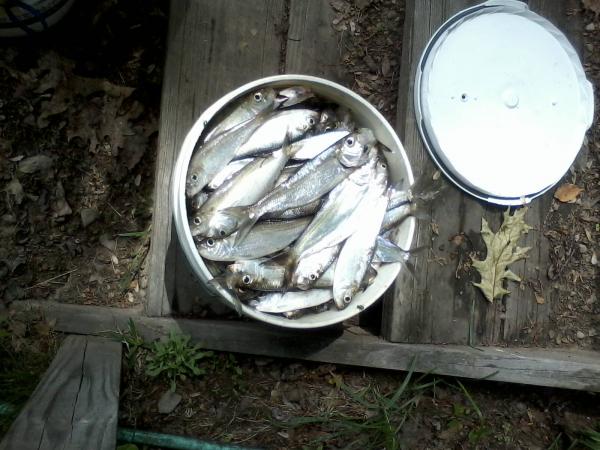 Sabiki rigs are easy to use. I use them all the time in Florida to catch bait fish. You basically just put a 1 or 2 oz weight on the end of it, drop it down into the water a few feet and jig up and down. Once a fish is on, you just pull it out of the water. Guys who are experience, will just shake the sabiki rig and the fish come off without tangling the line.
 -
Seneca Lake downriger/dipsy setup help
TyeeTanic replied to jimalbert's topic in Finger Lakes Discussion
I fish Lake O. I can't comment on the rating of your downrigger, I have used Scotty and Walker. As for the weight, I would use minimum 12 lbs, and if you can 15 lbs. The torpedo is known to have the lowest drag profile in the water, and therefore the least blowback. As for dipseys, well let's start with the rod. I like to use a rod that is longer than the rigger rods, to help get me over and far away from the rigger line. It helps when you have set the rigger and you need to release the dipsey line. So typically my rigger rods are 8 ft and my dipsey rods are 9 to 10 ft. What kinds, there's a lot of nice rods out there, but if you use wire, you should get a roller rod. Talora makes a nice one (that's what I use), but they are big $$. Anyhow, if you can find a rod with similar rollers to what the Talora uses, then it should be good. Note, not all rollers are the same, some designs are bad and the wire gets stuck between the roller and the guide. In terms of line, you have 2 choices, braid and wire. Mono has too much stretch and at lengths of more than 100 ft, it's almost impossible to pop the dipsey. Once the fleas are out, the braid will be a disaster/unusable. My advice is go to wire, you can use it year round. I use 7 strand, torpedo wire, smoked, 30 lb. Get a 7 strand or 19 strand. I don't think the 19 strand is worth the extra money, I have 7 strand that is 4 years old and still in great shape. If you take care of it, it lasts long. Do not go for single strand wire (yes, you can by this), it is terrible. You want to get 1000 ft of it, or 300 yards is close enough. So, if you get wire, what reel do you use? A size 30 reel will fit some braid backing (about 100 to 200 ft) and 1000 ft of wire. You want one with a line counter, so you know how much line is out, and how deep your dipsey is (more or less). I use Oukuma Convector 30D reels, they are in my opinion the best value for money out there. Others will chime in, and there are better reels out there, but I think you need to spend $100 more per reel to get any market improvement. -
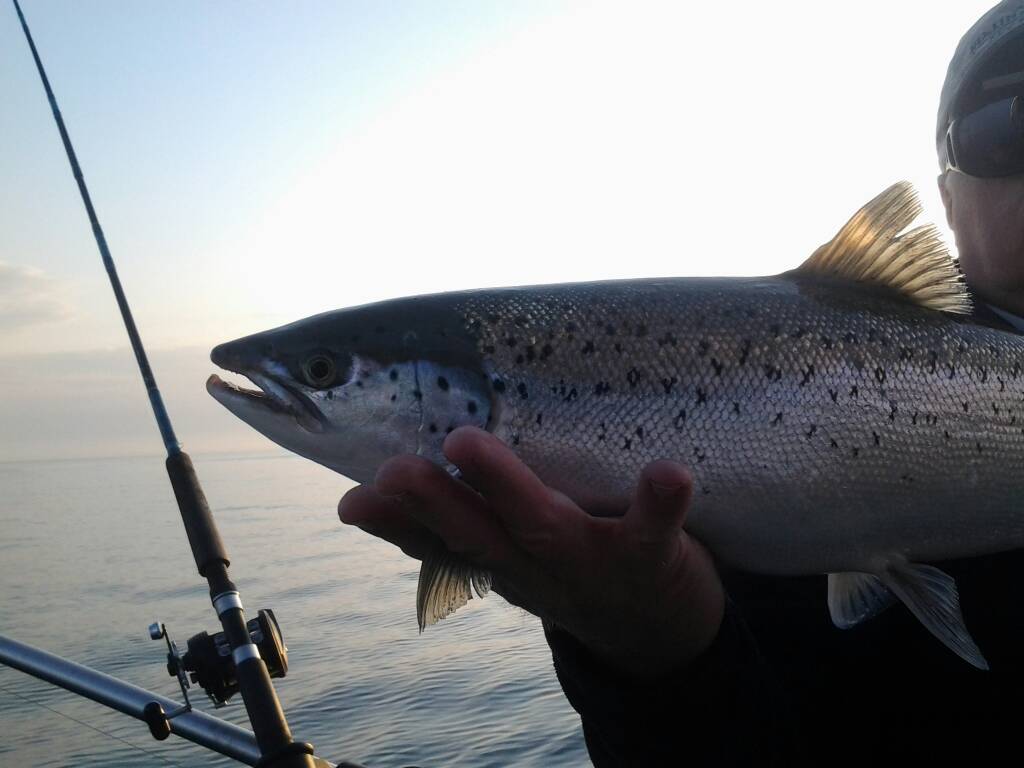 I've caught 2 on the north shore. Got one last year. I have seen more and more caught as time goes on, well at least reported. There's already 2 or 3 reports of atlantics caught in the past 2 weeks.
 -
Downrigger Weight and Sub Troll Probe
TyeeTanic replied to overthelimit's topic in Questions About Trout & Salmon Trolling?
A torpedo 12 lb weight is the min I would go for (it's what I use). There is still considerable blowback, but not bad. If your downrigger and mounting can take it, I would go with a 15 lb weight. -
VHF and DSC testing
TyeeTanic replied to TRAILN's topic in Ontario, CA Fishing Reports - Lake Ontario (North Shore)
You can request a radio quality check with the coast gaurd. They will give you two numbers that go up to 5, with 5 being the best. First is how clear when he heard you, and second is how continuous (are you breaking up). You can hail them on 16 and they will tell you to live to another channel. Last I heard you cannot make a distress test on DSC, so I'm not sure you can test it, unless you communicate with other boaters via a DSC call. -
Braid and dipsy divers
TyeeTanic replied to fish-on's topic in Questions About Trout & Salmon Trolling?
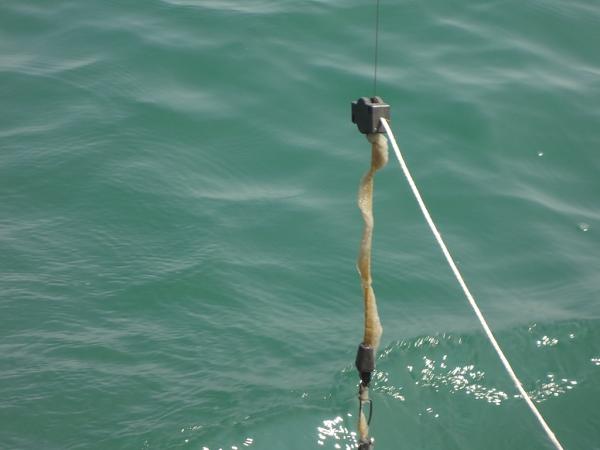 We often fish with 2 dipsies off either side of the boat, 4 in total.