


TyeeTanic
-
Posts
1,560 -
Joined
-
Last visited
Content Type
Profiles
Forums
Events
Gallery
Store
Everything posted by TyeeTanic
-
 Nice job!
 -
garmin lakemap contours way off. Anyone else have this problem?
TyeeTanic replied to Fishstix's topic in This Old Boat
Sounds like your GPS is off. The contours should be correct. So you figure the depth difference could be produced by the GPS being off by 400 ft. Your GPS should be able to predict within 30ft. Do you have a way to see how many satellites your connected to? If it's only 3 or 4, you could easily be that much off. If it's 7 or 8, then there must be something wrong with the unit. -
Scotty, right now you want to try and find warm water. The lake is like 36 - 39F, but there are pockets of warm water. So probably troll close to the nuke plant. I fish out of Oakville, so don't know your area all that well. Warm water is close to shore normally. For us we would be looking at much shallower water like 10 - 30 ft. Otherwise, you need to go way out to the middle of the lake (not recommended right now) and find warmer water. Also what works is trolling the edge of a mud line, which attracts bait fish and trout behind them. Not sure if you have any rivers out that direction, but river outlets form great mud lines. Troll edge of mud and clean water.
-
Doghouse has given you good info.
-
fished the oak today
TyeeTanic replied to CHAMP99B's topic in New York Fishing Reports - Lake Ontario (South Shore)
Nice. What colors were working for you? -
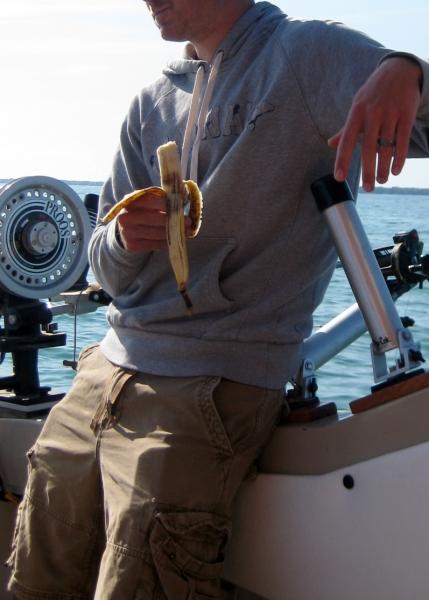 So I have my dad on board and he pulls out a banana. I start telling him about how they are bad luck. No sooner than I finish explaining it to him, as he is chomping on it, a big fish hits the wire diver. So he says, looks like that theory is right. Lol.
 -
Best fluorocarbon line/leader material ?
TyeeTanic replied to lineman49's topic in Tackle Description
I use pline and Seagaur. Both are good, but I like Seagaur better. -
2 stand alone's or a ff/gps combo?
TyeeTanic replied to NickR's topic in Questions About Trout & Salmon Trolling?
I say because the two separate units includes and hds7,then go with 2 units. You will be glad to have a full screen chart and full screen ff. I have a ff/GPS unit and another separate GPS. I pretty much always have the ff on full screen and rely on the other unit for my position. -
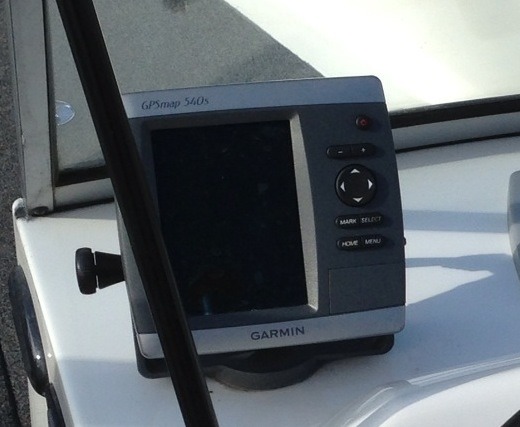 Are you still in the process of making a decision? There's a lot more difference between the 7 HDI and the 5 HDI. First the 7 can read high capacity detailed maps, while the 5 can't. The 7 also has a much better/stronger sonar. I would not go for the 5,bit rather go for the 7. The alternative is to get the HDS 5,which has all the good features the 5 HDI doesn't have.
 -
OK, after being questioned by Wallyandre, I did some digging. It seems the Elite 5 series has limited mapping capabilities (can only read up to a 2GB card) and a weaker sonar. But the Elite 7 HDI has SD high capacity capability, and the same sonar as the HDS - so it's an upgrade from the Elite 5. The high capacity SD is important as some map chips are bigger than 2GB. Andre refers to the navionics chips, but all the ones I've seen only have 30ft contours. The Lake Insight map for lake ontario is around 8 GB and has 3ft contours. So depending on which lake you fish on, and what you need it for, you may be interested in a unit with a high capacity SD reader.
-
The short answer is yes. I have an HDS5 200/83 and all is good. I generally stick to 200Hz, but will go to 83 if I'm hunting for where the fish are, as it covers more ground. The lake insight map comes with very detailed maps of Lake O, at least they did when I bought mine. I have contours every 3ft. So you should be good. Here's an excerpt from Lowrance's site: Cone Angle A transducer's cone angle determines its coverage area of the underwater world. The wider the cone angle, the greater the area that's covered. We offer a variety of 200 kHz transducers with either a wide (20°) or narrow (12°) cone angle. The 50 kHz transducers come with a 35° cone angle. The dual-frequency transducers come with both a narrow (12°) 200 kHz and a wide (35°) 50 kHz cone angles. And the dual-search transducers come with both a narrow (12°) 200 kHz and a wide (35°) 83 kHz cone angles. Generally, use a wide cone angle for fishing shallow to medium depths. The narrow cone penetrates to deeper depths, but shows less fish and structure due to its narrow beam.
-
I agree, the HDS5 is a great unit, but I would love to have that 7" screen for split screening the GPS and sonar.
-
There's another big plus going with the HDS vs. the Elite. The Elite can only read map cards up to 2GB, while the HDS can read map cards up to 64GB. This means you cannot view maps with major detail on the Elite (such as 3 ft contours), while you can on the HDS. These highly detailed maps help you locate good lake structure that will hold fish. Also, I believe the HDS has a stronger sonar signal. It is fully digital while the Elite is an analog signal. I had an Elite 5 and changed it to the HDS 5, way better - my maps are awesome and my tracking is really good too.
-
Best answer so far. If that's all it took to get my wife fishing, I'd put spinning reels on the boat. lol. Anyhow, the drag system is much better on the level wind, as the line comes out tangentially to the drag, whereas with spinning reels the direction of force (from the line) needs to be redirected to the drag which is offset by 90 degrees. In the end you have the spool on a spin reel have a force not around the axis, but off-centered. The simpler answer is it pulls the reel to one side, so the full drag isn't really working evenly. That's why for big game fishing you will always see level wind reels. You can have much stronger drag mechanisms this way. But who cares, if she wants to use them, let her use them.
-
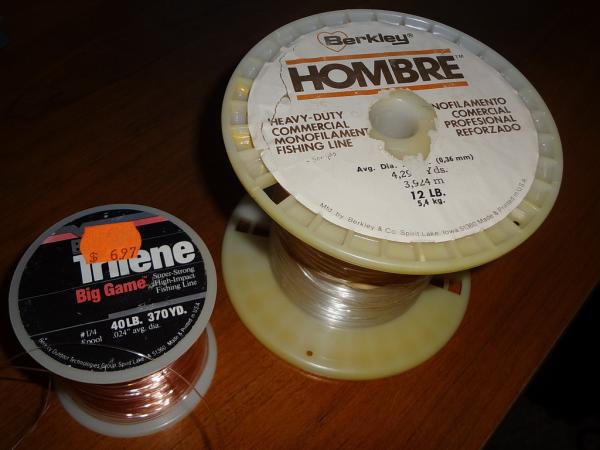 I used to use 20lb flea flicker. Had too many break offs. It kept the fleas off, but I found it would twist sometimes, even with good quality swivels (spro). The swivels did help a lot, but if something went slightly wrong with deployment, it twist and weakened the line. I changed to 30lb big game, and had no fleas on the line, plus it is strong as heck, and it's a lot cheaper than flea flicker.
 -
Preferred speed while trolling
TyeeTanic replied to Guppy35's topic in Questions About Trout & Salmon Trolling?
Exactly. Zig zag and pay lots of attention to details. Don't come to conclusions too quickly. -
Preferred speed while trolling
TyeeTanic replied to Guppy35's topic in Questions About Trout & Salmon Trolling?
Tom, we are on exactly the same page. On everything you said. Have fun. -
Preferred speed while trolling
TyeeTanic replied to Guppy35's topic in Questions About Trout & Salmon Trolling?
Tom, nOT poking fun here. But, you start by saying speed isn't important then finish by implying it is very important. Anyhow I get what you are saying. Down sped gives you a good starting point when you are in unknown waters. Once you know what speed is working, like you say, you need to repeat. If you know the waters on the other hand, you can probably use GPS speed. -
Preferred speed while trolling
TyeeTanic replied to Guppy35's topic in Questions About Trout & Salmon Trolling?
Well, most accurately? It depends on what you are trying to measure. GPS is better for speed over ground, but down speed (probe at cannonball) is better for speed of lure through water. What is most important for trolling is the speed of the lure through the water - as this imposes a certain action on the lure which will either attract fish or turn them off. Currents can change a lot, so maintaining a GPS speed means that your lure through water speed will vary significantly. I don't know where you are fishing but the worst I've seen is around 0.8 to 1.0 mph currents. So think about trolling in 1 direction and then turning around 180 degrees and trolling back. The lure speed will be different by 1.6 to 2.0 mph between the two directions!!! When this happens you will see it in your rods, they will either be bent over backwards from high drag, or loose due to no drag. On Lake Ontario, for salmon most guys I know stick between 2.2 to 2.8 mph down speed, with the average starting point at around 2.5 mph. -
Chas, they obviously can last longer, but I have been told they can go after 5 years. Also they might mark, but not work as well as they used to. Also my info is specifically for Lowrance units. Not sure how much it differs with other brands. Finally I've also heard that it depends on whether you leave your boat in the water or haul in/haul out frequently (the later can lead to earlier probe failure). For my situation, it is difficult (costly) to haul my boat out of the water, so I don't want to be caught finding out I have a problem mid season. I'd rather just change the probe every 5 years. The haul alone would cost me more than several transducers. If it's easy for a person to haul their boat out of the water, then I wouldn't be changing them out until I have sufficient evidence the transducer is failing.
-
storage of dodgers and flashers and dipsys
TyeeTanic replied to BAITNH's topic in Tackle Description
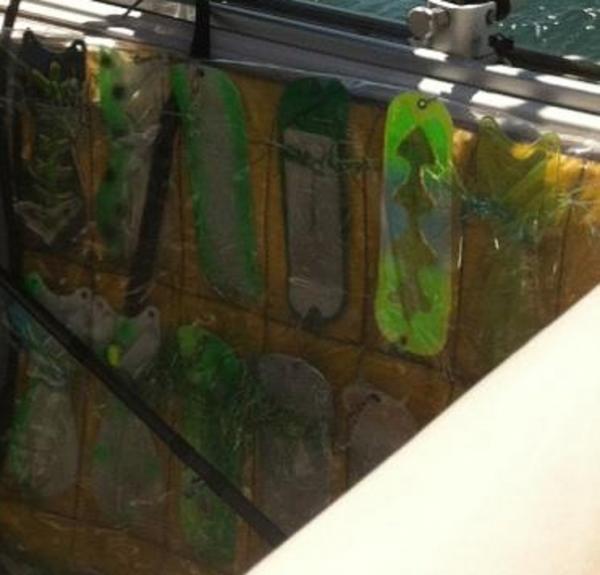 Hey momay, I would agree that the simpler the better. But I can assure you these combos as shown are very popular. For instance the purple combo in the right pouch was a killer in 2012.thqt froggy pattern was amazing in 2012 and 2013. The Carmel dolphin pattern put the biggest fish in our box in an April tourney. Hawg Wild was incredible in 2011 and good in 2012. I can go on, but have admitted some patterns are experimental, I'd say around 30%. For those we change the combo until they either work or go up for sale. Lol.
 -
storage of dodgers and flashers and dipsys
TyeeTanic replied to BAITNH's topic in Tackle Description
Thanks guys. It took many hours (believe it or not) to carefully go through all the colors I had and match up the dipsey, flasher and bait in a color pattern that works. I have some experimental sets in the mix, but most are tried and tested (successfully) combinations. Each particular pouch represents a target depth. I have my shallow water setups (up to around 30 ft deep), mid depth setups (30 - 60ft deep), and deep setups (more than 60 ft deep). I also have a "favorites pouch" - one on the very right side. Sorting by depth is helpful, as there are colors that work better at certain temperatures and others that don't work at all in a certain range. So really the sorting is more by colors that work at each given range of depth. When it's hot and we are fishing deeper, everything is ready to go. When the fish are shallow, all set again. -
storage of dodgers and flashers and dipsys
TyeeTanic replied to BAITNH's topic in Tackle Description
I went back to the main menu and selected the 052 model. It takes you back to the 0522 screen, so maybe they're the same? All I know is that they are about 16" wide and about 3 ft long when rolled out. Here's a picture of my four bags with the tackle inside. -
You should change your transducer every 5 years.
-
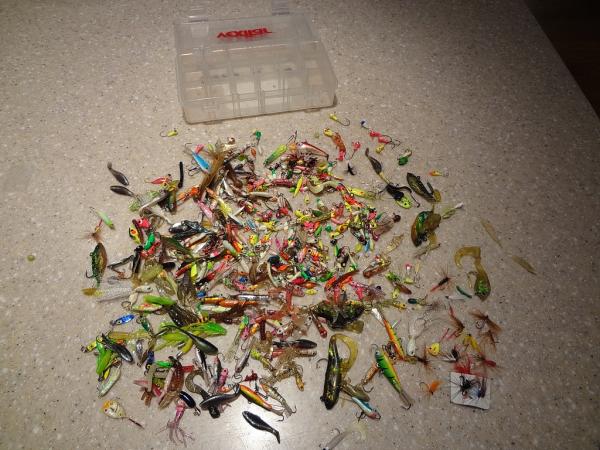 Ok, not an ice fishing accident ... but I think it still counts. I was thinking of changing one of my trolling setups, so I got my favorite dipsey out, connected it to an awesome looking spin doctor and fly, all while my first mate was reeling in the rod I wanted to change. He took off the tackle originally on the rod, and I turned around to do something. Turned back to drop the new rig into the water. Threw it overboard grabbed the rod to let it out, but there was no pull. I watched as all that tackle sank out of site, as between the two of us we each though the other had connected it to the wire line. It was like throwing a $50 bill into the water. Awesome!